

Article by Julie Waechter, special to Adams State
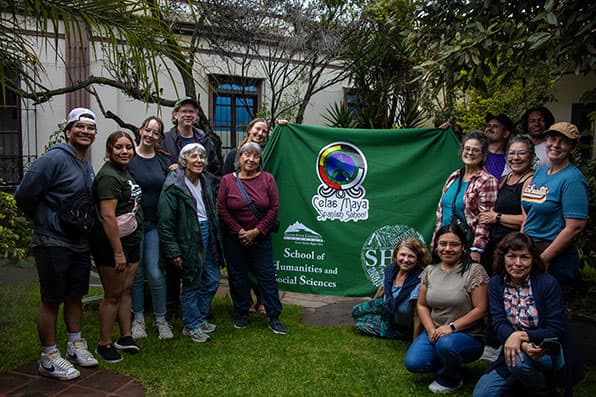
Pictured, left to right: Andrew Solis, Mayra Cristobal, Kora Marvin, Mary Van Pelt, Dr. David Lee, Kathleen Archuleta, Stephanie Framel, Mavi Valdez-Apodaca, Alejandro Apodaca, Tamara Rael, David Smith, Maria Kramer. (front, from left to right) Dr. Artemis Preeshl, Dr. Meliza Ramirez and Gloria Reyes, at Celas Maya School.
Fifteen students and community members recently experienced a ten-day academic tour of Guatemala as part of a unique course at Adams State University. They invite the community to attend a panel presentation on the tour, “Beyond the Classroom: A Journey through the History and Culture of Guatemala,” at 12 p.m. Friday, Nov. 13, in McDaniel Hall 101. There is no admission charge, and pizza will be provided.
Meliza Ramírez, Ph.D., assistant professor of Spanish, and David Johnson Lee, Ph.D., assistant professor of history, are co-teaching “Special Topics: Guatemala – Language, Culture, and Democracy” and “Special Topics: Cultures & Civilizations of Latin America.”
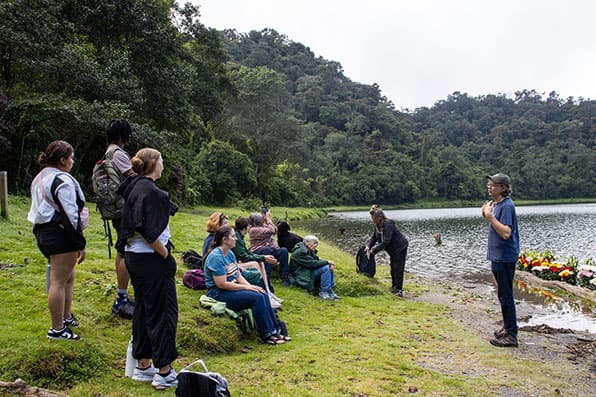
Dr. David Lee presents on Laguna Chicabal, a holy Mayan lagoon deep in the jungle.
Dr. Lee explained, “The goal of the trip was to familiarize students with the history and culture of Guatemala, especially as they relate to democracy in Guatemala and the United States. Also, given the relatively large Guatemalan population here in the Valley, we wanted to help students understand the culture and background of their neighbors here.” According to the San Luis Valley Immigrant Resource Center, the San Luis Valley is now home to more than 400 Q’anjob’al Mayans (Guatemalans).
The trip was funded by a State Department IDEAS grant, which aims to enhance international education opportunities for American students. Drs. Ramirez and Lee coordinated the trip with Guatemala’s Celas Maya Spanish School. The group lodged with local families during the ten-day trip, toured historic and cultural sites, and attended lectures on a range of topics.
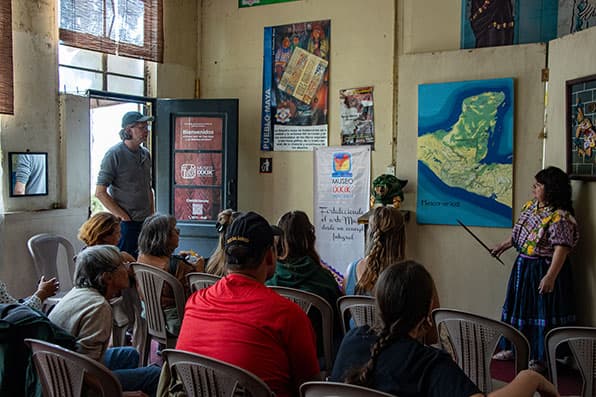
Dr. David Lee translates a lecture on cultural lands of indigenous Mayan tribes.
Students prepared for the trip by studying The Guatemala Reader: History, Culture, Politics, then completed writing assignments and planned their research topic. Those enrolled in the Spanish course read the assignments and wrote essays in Spanish, while the history students completed assignments in English. Some of the final research topics include Guatemalan textiles, the history of Guatemala’s civil war and genocide, and Guatemalan women in politics.
Dr. Lee explained Guatemala was embroiled in civil war from 1960 through 1996, precipitated by a coup in 1954 orchestrated by the CIA. The Adams State group attended presentations by the Guatemala Human Rights Office and the Commission for Historical Clarification. According to Wikipedia, the Commission found more than 200,000 people were killed or disappeared during the conflict, including many children, priests, indigenous leaders, and innocent women and men.
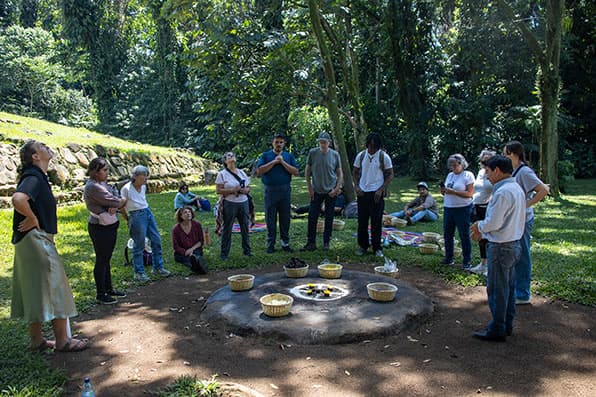
Director of Celas Maya Spanish School, Federico Velásquez, guides the class through a Mayan ceremony.
Community member Mary Van Pelt said the trip was “Really significant and well organized. We learned a lot about Guatemala. I am always interested in indigenous sacred traditions.” She particularly enjoyed the group’s tour of the Chicabal Lagoon, which entailed descending a crater via 500 wooden steps to the sacred Mayan site.
The tour was particularly meaningful for Adams State senior Mayra Cristobal, who acted as interpreter for the group. Her parents had fled Guatemala individually in the 1990s, then met in Alamosa. Thus, Cristobal is trilingual, speaking the Maya language Q’anjobal, Spanish, and English. She is a double major in Spanish and social sciences, with an emphasis in forensic science.
“I cried twice on trip; it was very emotional. I loved it there and made so many connections. It felt like home, and I want to visit again,” she said. “This experience made me realize how much I take for granted in life – my classmates had similar reactions. My family sends clothing to my cousins in Guatemala twice a year, but I never realized before how important that is. I better understand the poverty my parents once lived in.”
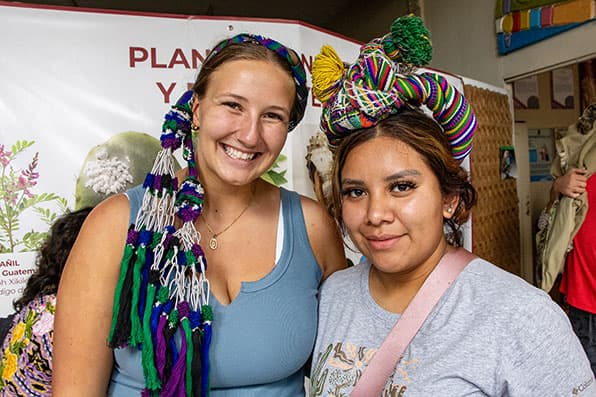
Stephanie Framel and Mayra Cristobal wear a traditional Mayan headdress called a Tocoyal.
Noting her family is devoutly Catholic, Cristobal especially appreciated being able to participate in a Mayan ceremony at Chicabal Lagoon. “I have one uncle who is extremely passionate about Mayan culture, but I never truly understood what it meant. Now I value my traditions even more.”