


Frequently Asked Questions
In January 2025, the Human Resources team partnered with Huron Consulting Group, a consulting firm specializing in higher education, to design a new compensation program. The following information pertains to the development of that program.
Huron Presentation Overview – Faculty and Staff (PDF)
General Questions
Human Resources developed the new compensation program in partnership with Huron Consulting Group. We leveraged their subject matter expertise, tools, and resources to develop an initial framework. Throughout this partnership, we utilized both internal (e.g., pay structures, position descriptions, employee census information) and external information (e.g., salary surveys, market-leading practices) to shape our approach.
Professional Administrative Staff members, and most faculty will be governed by the new program. Classified staff, adjunct faculty, and visiting faculty are excluded.
Huron Consulting Group partnered with ASU’s Human Resources to develop the new compensation program. This is happened under the direct supervision of Kevin Daniel (VP of Administration & CIO) and Tracy Rogers (Director of Human Resources) who were supported by a the HR staff, a constituent advisory group (two faculty members and two PASC members) and an executive advisory team including Margaret Doell (Provost) and Kyle Glenn (Special Assistant to the President) . Kevin, Tracy, alongside executive team members, served on the project Executive Team and that were responsible for final decisions related to program development.
As active participants in the project development, the Executive Team (“eTeam) (President David Tandberg, Provost Margaret Doell, Vice President Advancement Jake Rissler, Vice President Administration Kevin Daniel, Vice President Student Affairs Saval DeVoge, CFO Heather Heersink, Executive Equity Officer Florencio Aranda, and Director of Athletics Katelyn Smith) serve as your primary contact for project questions and feedback.
The new program includes job classification, compensation operations, and compensation administration components:
- Job classification (staff only) groups jobs by function (the type of work) and level (the complexity of the work).
- Compensation operations include tools and resources that we utilize to determine appropriate pay for each employee.
- Compensation administration includes resources that we utilize to oversee day-to-day functions of the program. .
It is important to periodically refresh our understanding of the external market and evaluate our compensation program against similar institutions. We have opportunities to update our program to better align with current market-leading practices and University goals. We made these updates with a focus on the following objectives:
- Promote a consistent approach to compensation University-wide
- Attract, retain, and reward talent
- Enhance analysis and reporting capabilities
- Reduce administrative burden for HR personnel
- Enhance the employee value proposition (see: How does this benefit me?)
- More fully utilize the new Workday HCM
We set out to design a program that will improve the employee experience. Some of the benefits to you include:
- Clearer understanding of how work is organized and compensated across the university
- Increased transparency around compensation decisions
- Enhanced focus on pay equity for employees performing similar work at a similar level
Yes. This is our first iteration of our new compensation program. As the University and higher education landscape continue to evolve, our program will adapt as well. This includes our staff job classification framework, pay ranges, market strategy, and anything else that impacts your compensation.
A comprehensive governance document is being developed which will outline our commitment to the methods and frequency of reviewing and updating each component of the compensation program. We will communicate these decisions when they are finalized.
The compensation program includes a consistent, data-driven approach to setting and adjusting pay. This project will help ASU understand the relationship between current compensation and the market, to inform compensation planning going forward. We will balance the need to be competitive and available resources to prioritize increases. There are no guaranteed pay increases as a result this project. Employees will not receive pay reductions.
As an immediate outcome of the new program, ASU does not plan to:
- Change the core responsibilities of any position
- Adjust reporting lines, including direct supervisors
- Reduce employee pay
- Eliminate positions. This program is meant to provide consistency in determining pay and structure around career growth opportunities. We do not anticipate material changes to your day-to-day work.
We expect program development and implementation to last through March 2026.
We welcome questions and feedback. For these purposes, your eTeam member will be your primary point of contact. If they are unable to address your question, they will pass it along to the Human Resources team.
Compensation Philosophy
A compensation philosophy is a formal strategy detailing ASU’s commitment to employee compensation. It includes compensation program goals, components, and high-level governance considerations.
Per the updated compensation philosophy, the goals of ASU’s compensation program are:
- To be aligned with market-leading compensation practices
- To provide similar pay for similar duties, promoting internal equity across ASU
- To provide compensation aligned with the competitive labor market
- To maintain fiscal responsibility and sustainability
- To promote clarity and transparency around pay and pay practices
- To be flexible based on the changing industry and market landscape
Adams State University (ASU)’s compensation philosophy is designed to support the University’s purpose and strategic priorities. It serves as the foundation for a comprehensive compensation program that seeks to recruit, retain, and competitively compensate employees, while maintaining fiscal responsibility and sustainability. Achieving the Adams State University mission depends on our ability to support and develop our workforce to meet the needs of our students, campus, and community.
Market Strategy
A market strategy defines the talent market ASU competes in for different types of jobs. It includes components such as industry (e.g., higher education, general industry), geography (e.g., national, regional), and use of peer groups (i.e., comparable higher education institutions). It also includes a target position (i.e., percentile of salary survey data) in the resulting talent market. It may vary for different types of jobs, depending on their function and complexity.
We will utilize CUPA-HR’s surveys to benchmark all faculty and Professional/Administrative staff jobs. CUPA-HR is the leading survey provider for the higher education industry. The size and accuracy of its data set provides a strong basis for compensation analysis. To learn more about CUPA’s surveys and methodologies, visit their website, located here: CUPA-HR Website.
ASU’s labor market includes comparable institutions in the higher education industry. These institutions are selected based on criteria set by university leadership and Human Resources. The labor market peer group criteria is 1) Public Institution 2) Primarily award Bachelor and Masters degrees 3) Similar operating expenses 4) Participates in CUPA surveys.
For all faculty and Professional/Administrative staff jobs, we will utilize percentiles of the labor market to determine target compensation. This is a shift from our current model for faculty, where we were using a percent of average.
This shift aligns with how the market thinks about compensation, enhances the precision of compensation analyses, and unifies terminology across the institution. The use of percentiles reduces the risks involved with outlier sensitivity that may distort a true picture of the market. Additionally, percentiles allow ASU to adjust their market target if appropriate.
The use of percentiles does not indicate an increase or decrease in the market target for faculty. Instead, it represents a change in terminology and practice to better administer compensation.
ASU’s market strategy includes three key components:
- Organization Type: ASU utilizes higher education data. It is sourced through salary surveys conducted by the College and University Professional Association for Human Resources (CUPA-HR).
- Market Comparison Group: Within the higher education industry, ASU utilizes a group of peer institutions with similar characteristics for market pricing. The peer group (updated in 2025) includes 130 public institutions with comparable Carnegie Classifications and operating expenses. These institutions also participated in at least one CUPA-HR survey in 2024-2025. We expect this peer group to change slightly year-over-year, accounting for changing dynamics in the market data and institutional demographics.
- Target Market Position: ASU targets the 30th percentile of the resulting labor market.
What is ASU’s Market Pricing?
- Per the Market Strategy, ASU targets pay at the 30th percentile of the relevant labor market for each job. The resulting Target Percentile Rate is based on (1) the job’s market match in a CUPA-HR survey, and (2) adjustments for data aging. It is intended to reflect compensation for an employee who is fully contributing to their role. All pay decisions are made in relation to this rate.
- Each administrative & professional role is assigned to a job in the Job Catalogue, which includes a Target Percentile Rate that determines the job’s pay range. When a direct market match is unavailable, Human Resources identifies a proxy match with a similar function, then adjusts the resulting pay range to reflect differences in complexity between the job and proxy match. Market pricing processes are standardized and not modified for individual positions. Any exceptions must be escalated to the e-team for approval
ASU’s salary structure is comprised of sixteen (16) pay ranges, which define a minimum and maximum salary. Pay range assignments are made based on the target percentile rate for a job, per the Market Pricing section. All employees will be paid within the range for their position.
ASU will review, and may adjust, its pay ranges every year. Human Resources and the e-team will collaboratively determine appropriate adjustments, based on market movement and available funding.
Adjustment to the salary structure does not necessarily result in individual pay changes, unless the individual is paid below the pay range minimum. 2025-2026 pay structure can be found here.
Staff Job Classification
A job classification framework categorizes jobs based on the function and complexity of work they involve. To define “function,” or the primary type of work performed, ASU will use job families and sub-families. To define “complexity” of work performed, ASU will use career streams and job levels.
Finally, we will implement a titling framework, which helps us develop standardized job titles based on the function and complexity of a job. Current titles will not change as part of this project, but we will implement the framework moving forward.
The classification framework only applies to Professional and Administrative staff members, including executives. Classified jobs will continue to use the state classification system (see: Who is included in the new program?).
Broadly, job families and sub-families define the primary function of a job. Job families are a collection of jobs with similar knowledge, skill, and ability requirements. Sub-families are specialized subsets of job families.
An example of a job family is Human Resources. Potential sub-families for Human Resources include Talent Acquisition, Benefits, or Employee Relations.
Broadly, career streams and job levels define the complexity of a job. Career streams define the fundamental nature of work performed. Multiple job levels exist within each career stream, to differentiate the complexity of jobs within them.
An example of a career stream is Managerial (M), which includes all non-executive “people managers” (i.e., jobs with direct reports). Job levels within the Managerial career stream include Supervisors (M1), Managers (M2), Assistant Directors (M3), and more.
The table below shows the alignment of levels across the four career streams.
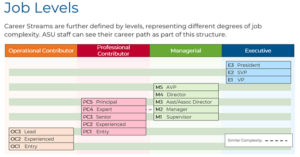
The framework was developed collaboratively with Huron Consulting Group. In part, it is based on market leading practices – or the most effective ways that other universities categorize their jobs. We also considered the unique structure and types of jobs across Adams State, ensuring the framework represents all Professional and Administrative jobs.
While we do not expect to make extensive changes to the job classification framework, it will be adjusted over time. Periodically, we will review job families and sub-families to see if additions, removals, or edits to language are needed. We will also review career streams and job levels for language changed, but do not anticipate adding job levels in the near future.
The Human Resources and Core eTeam are working through a process called “mapping.” This is where we align all Professional and Administrative jobs to the new classification framework. We assign each job a job family, sub-family, career stream, and job level.
The employee mapping process included three phases of work.
Phase 1: Initial Mapping
Huron Consulting Group reviewed available job data, including position descriptions, employee census information, and organizational charts. They used this data to align jobs to the new classification framework.
Phase 2: HR Validation
The Human Resources team reviewed and provided feedback on Huron’s initial mapping. During this phase, we identified position descriptions that may be outdated, inaccurate, or lacking appropriate nuance, to adjust mapping accordingly. We collaborated with leaders across the institution and requested updated position descriptions.
Phase 3: Core eTeam Validation
The Human Resources team collaborated with the Core eTeam and Huron experts to validate mapping. During this phase, eTeam members evaluated each of their jobs and ensured accurate mapping to the framework.
Yes, your classification can change over time. There are three primary ways this could happen:
- Job Change: Your classification will be updated to reflect the new function and complexity of your job.
- Promotion: Your level may change as you take on more complex duties, acquire direct reports, and are required to perform duties that align with the next level.
- Structural Framework Adjustment: We may make changes to the classification framework that would shift your classification. This is more likely to occur with functional shifts (i.e., adding a new sub-family due to a new type of work at ASU).
No, your job classification will not impact your working title.
Each employee has received a communication from HR providing job classification and compensation details. HR is working on a job architecture project to move all the job classification elements and pay structures into workday where you will be able to review.